
The War on Human Creativity
#275 on studio ghibli and AI, art and content, and the things that will destroy society (not hyperbolic at all)

Dear reader,
One of the first lessons from my sketchbook habit was that art is fun to make regardless of how the drawing turns out. The joy of art is entirely in the process, not the result. Children already know this but the process of adulting requires us to forget. Growing up is a process of indoctrination in many bad ideas. One of the worst is the idea that you should only do things you are good at doing. Growing up is flipping the switch - from doing things because they bring you joy, to doing things only if the result is good.
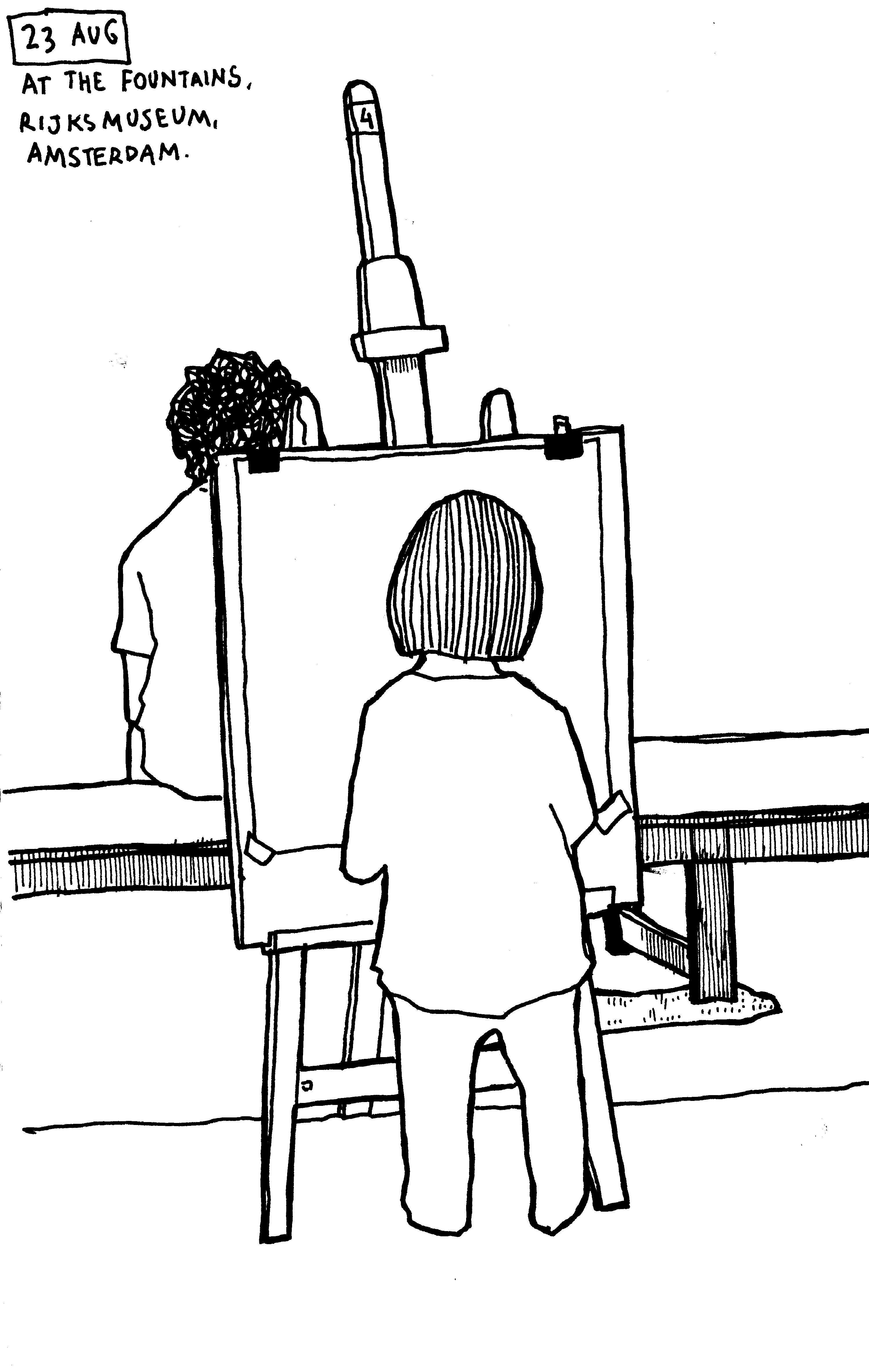
Another bad idea is that things are only worth something if you can possess them. Possession is the greatest virtue. This is why the most popular room in any museum is the gift shop.
I am thinking this week about the Studio Ghibli filter by OpenAI, the banality of its evil, and human nature.
Read to the end for tickets to Sketcher Fest in Edmonds (WA), and a chance to watch me draw later this week.
The SneakyArt Post is a newsletter of secretly drawn art of the world. Every week, I share the latest pages from my sketchbook, and the best ideas from my journey as an artist and writer.
If you like reading this, share it with someone else.
This week, the internet was taken over by OpenAI’s new filter to render any image (or video) in the aesthetic of Studio Ghibli films. Everyone is putting everything into it - memes, memories, themselves, their children.
The first thing to clarify is that this is theft. But no one will be charged for it, certainly not individual users. Does that make it okay? Is that enough layers of separation that we are content to grab what is not ours?
It seems yes. Life is about grabbing what you can, posing beside it, playing it cool.
From reading Ways of Seeing by John Berger, I learned:
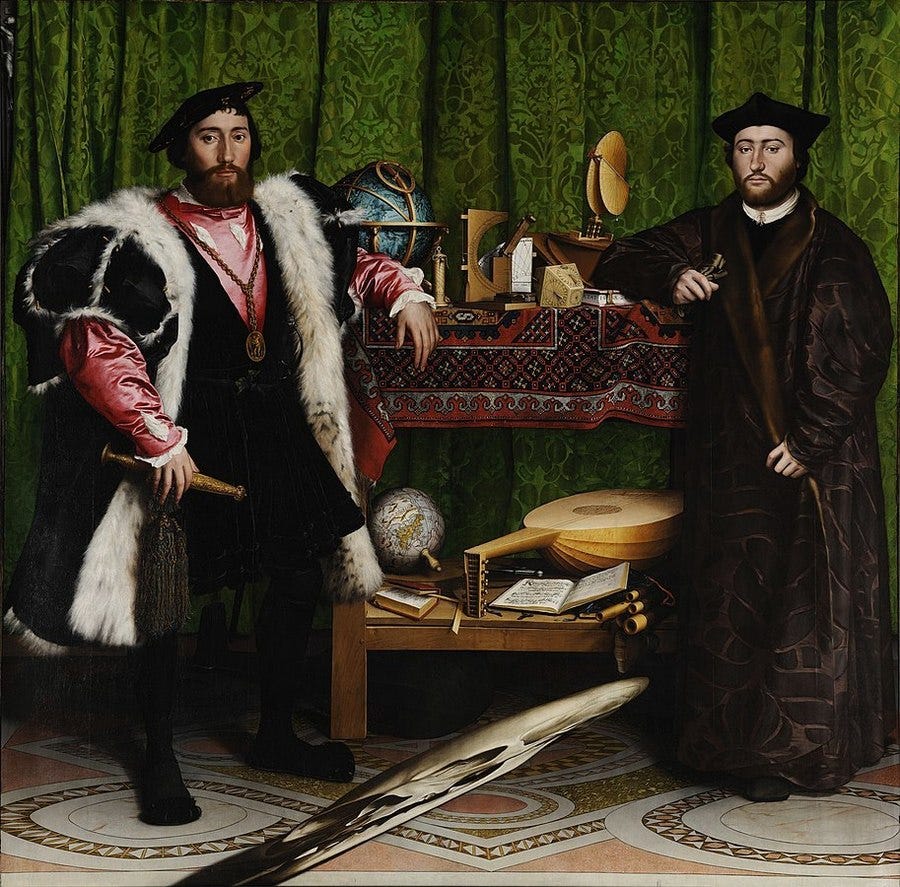
The job of the oil-painter of the European tradition then was to supply images in the burgeoning open art market for clients who wished to possess and project an image of themselves - of affluence, exoticity, adventure, spirituality, or desirability.
- “Are oil paintings just the selfies of yore?”, Jan 2025 (Keep reading)
But I do not want to argue the morality or the theft. Instead, this week I thought about what we lose when we play this game the tech-bros have made for us, that they insist we play, that they insert into everything we do now. I think it will destroy society completely.

SLOP
Despite the enormous amounts of electricity it consumes, there are many useful applications of AI. But in which world is it useful (or necessary) for it to make art Is art a high-paying profession? Are novels notoriously lucrative?
The purpose of AI generation is not to make art. It is to make content. Content runs the social media machines, content grabs your attention, content makes you dumber. Content is the junk food of the internet. An infinite content machine demands slop.
As explained by Ted Gioia -
Slop is a creative style that emerged around 2023 with the rise of generative AI. Slop art is flat, awkward, stale, listless, and often ridiculous. Slop works are celebrated for their stupidity and clumsiness—which are often amplified by strange juxtapositions of culture memes. (Keep reading)
Slop is important for the business of social media, because social media is not in the business of connecting people. The goal of social media is to run an infinite scroll of algorithmically-curated slop (interspersed with ads) in front of your eye-balls, shattering your attention span and monetizing every shard.
Social media does not care what happens to you. It will destroy your mental health, push you towards poor financial decisions, ruin your ability to enjoy other media, steal your time, and drain your energy. With VR glasses, it hopes to own and monetize every tiny pixel of your vision in every waking moment of your life.
The machine runs 24/7 and has made its owners the richest people in the world. But that is not enough. We are living through a very particular time in history. The key attribute of the richest people in the history of humankind is not their intellect, wisdom, physical prowess, or ruthlessness. They are defined by, united by, and best characterized by, the fact that they are utter, complete losers. As J. P. Hill writes -
It’s now been many months of Mark Zuckerberg trying to look cool, wearing a little chain that is clearly alien to him, and generally presenting himself as a young white guy who listens to mediocre hip-hop rather than a 40-year-old with over $200 billion. (Keep reading)
COLONIZATION
To quench their unquenchable thirst, they need to generate more and more content, faster and faster than before. Much faster than people can make art or draw comics or write stories. With AI they take the pesky human out of the equation. This is the colonization of all human culture.
Colonize (v):
To extract the value from a stolen thing without caring for how it was made or by whom, even at the cost of its destruction. To not care about what you destroy, because it was never yours, as long as you can squeeze every drop of its worth.
To call the destruction a tragedy, and the profits an inevitable necessity.
- “Art and Artificial Intelligence”, Dec 2023 (Keep reading)
“But it’s just silly fun and games, no offense intended! How can it destroy culture and collapse society, Sneaky? Stop over-reacting!”
This week, I thought of answers to this common refrain.
Step 1. Context Collapse: The flattening of culture
With access to the world’s art, literature, history, and all kinds of information, at our fingertips, out world should only become more rich, diverse, and complex … but social media makes the opposite true.
Context Collapse is the stripping away of reason, and circumstances, and motivations, and process. It is the phenomenon by which you see everything in the same way as everything else - just another post on your infinite scrolling feed. Whether it is the art of someone you deeply admire, or the rant of a frustrated artist, or videos of a devastating earthquake, or bombs dropped over innocent children, everything is reduced to content. Hit the like button, share to your story, add a comment, keep scrolling.
Context Collapse makes Hayao Miyazaki just another ‘cute’ aesthetic for people to usurp. Context Collapse explains why his life’s work does not belong to him at all, but should be open for anyone to play with in any manner they choose. For example, your friends who used it to filter their family pics. For example, the US Govt using it on a picture of an alleged fentanyl dealer.
In the words of Erik Hoel -
While ChatGPT can’t pull off a perfect Miyazaki copy, it doesn’t really matter. The semantic apocalypse doesn’t require AI art to be exactly as good as the best human art. You just need to flood people with close-enough creations such that the originals feel less meaningful. (Keep reading)
There is no worth to the painstaking hours, years, and decades it took to create the art style, the human values it espouses, to its rich, timeless stories, or the labour of love involved in doing it this particular way. Context Collapse leaves the value only in how the work can be exploited, all profits going to Silicon Valley.
Thus, colonization.
Step 2. Model Collapse: Why even try?
This is happening already. Besides consuming enormous amounts of power, AI needs to train on enormous amounts of data. So much so that AI models have already run out of … all the data on the internet. They are now feeding on other AI-created data, thus proliferating inbred data, also called Habsburg AI.
And always this is accelerated by the insatiable greed. Instagram now pushes you to “Create using AI” rather than finding an artist you like. Google’s Gemini searches the most relevant search results and directly gives you the information, depriving the original websites of referral traffic. What does this do?
Why be a real person on the internet any longer? Would you start a recipe blog if you knew that AI systems will immediately absorb your ideas and spit them out without credit to you? Would you post your stories online for an AI to absorb and regurgitate? Why spend years developing your craft and creating an art style, if it will immediately be captured and monetized by billionaire pirates?
This is how you kill human creativity.
Everyday, the internet becomes less real as real humans lose the incentive to share their human work, leaving only bots to talk to each other. This is happening already on Reddit. It has already happened on countless message boards and comment sections. Half of Facebook is just this. It is called the Dead Internet Theory. Google it, for irony’s sake.
So what is left for the humans to do?
Scroll the feed assigned to you.
So what is left for the humans to do?
Consume the slop designed for you.
So what is left for the humans to do?
Give social media your time and attention to turn into ad-revenue.
So what is left for the humans to do?
Collapse.

This July, I will be at Sketcher Fest in Edmonds (Washington State, USA). If you live around this part of the world, this is an unprecedented opportunity to meet some truly incredible artists (and me, as well).
Tickets go on sale Sunday, March 30 at 4pm PT. Tap the button to learn more.
I am doing a FREE webinar on Tuesday, April 1 at 12pm PT, to demonstrate techniques and share ideas about drawing the tiny people of your world.
Tap the button to learn more and grab your seat.

Dear reader, making art is the most intensely human thing you can do. Don’t let them take it away from you.
I am glad to have a portion of your time and attention every week. Thank you for being here. Big news to share next week, so stay tuned!
PS. If this post moved the needle for you in any significant way, gave you food for thought, or hope, or a good idea even, why not buy me a coffee? It is a simple way to say thank you, and I can really use more coffee.
I do not think it is a hyperbolic take at all. This timeline has taken a really dark turn. We are all interconnected, and I am sad that so many forces are trying to convince people that we are not.
As a novelist whose work has been stolen and consumed and repurposed; and whose fragile squiggly but joyfully fun attempts at art have been made irrelevant, I resonate. I need reasons not to give up. This truth telling helps.